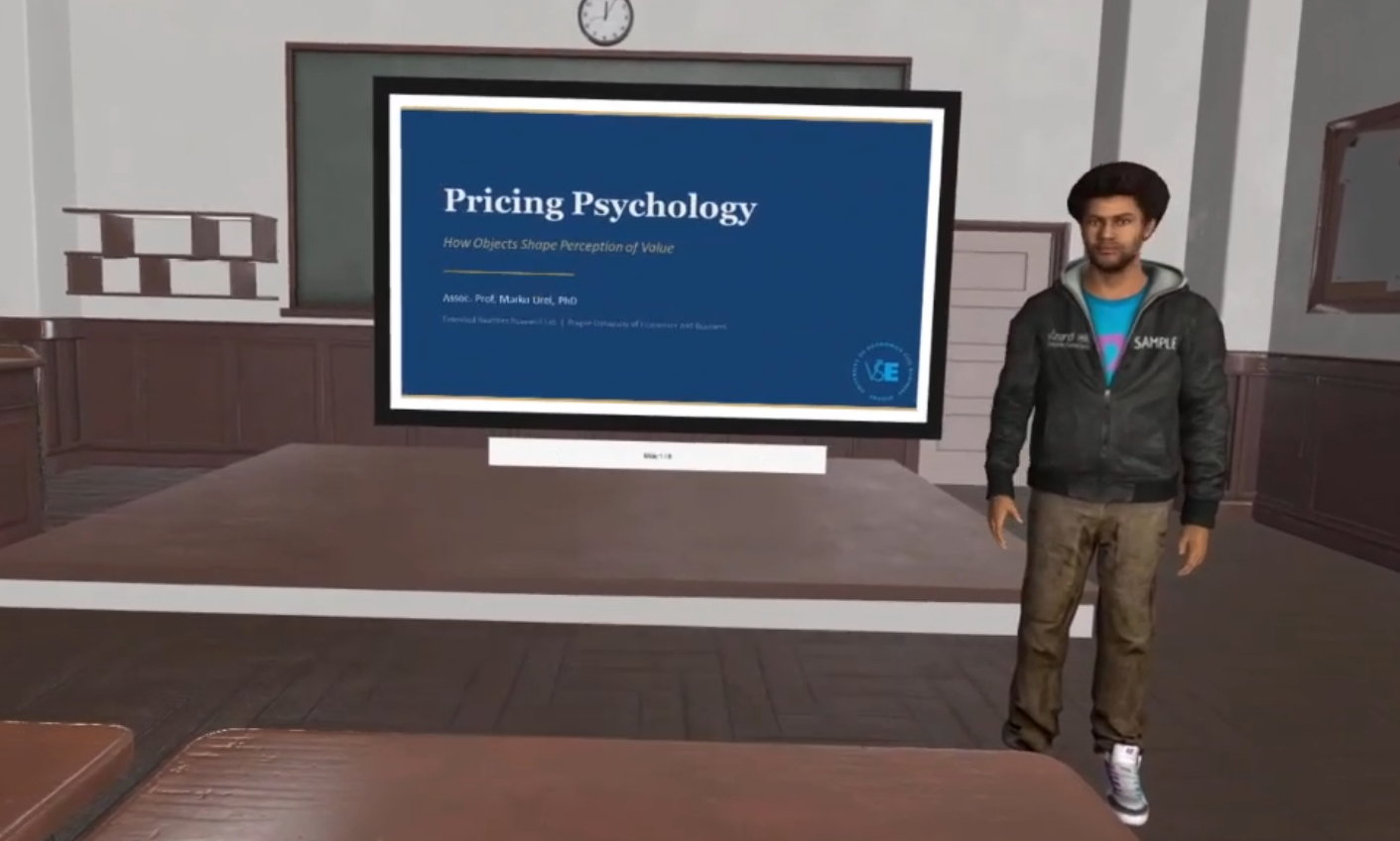
Exploring VR-supported teaching at ERRL
At ERRL, we are testing what teaching looks like when it moves into VR as a serious instructional medium, not as a novelty. We have built early teaching prototypes that run as guided lessons with slides, narration, and an avatar presenter, while interactive objects appear exactly when they matter in the content. The aim is straightforward: concepts should not stay abstract when VR can place them in context and let students engage with them directly.
One scenario explores how immersive context can support learning in subjects that often feel distant or purely textual. The lesson is set in an ancient temple environment and focuses on the economy of ancient Greece. Students follow a structured lecture sequence, while historically themed objects appear in sync with the narration, such as a wheat sack, amphora, merchant ship, and coin. Each object is intended to anchor a specific idea in something tangible: production and agriculture, storage and exchange, trade routes and logistics, and the role of currency and value. This approach treats the environment as more than a backdrop. It becomes an interpretive frame that helps students connect economic concepts to material culture and lived practice, while staying inside a coherent, narrated lesson.
A second scenario moves from historical contextualisation to behavioural decision-making in markets, with a focus on pricing psychology and consumer perception. This prototype takes place in a VR classroom and uses interactive objects, such as bottles with price tags, that appear depending on the slide currently being presented. Students can compare items, inspect differences, and interact with objects while the lecture continues, which supports a deeper discussion of how people interpret price as information, how perceived value is shaped, and why small changes in presentation can shift judgement and choice. The design is deliberately restrained: interaction is present, but it does not turn the lesson into a game or a branching simulation. Instead, it functions as an embedded demonstration layer, allowing students to test assumptions in real time while the theoretical framing remains clear and structured.
These prototypes are also built to be evaluated, not only experienced. Each participant enters an ID, completes the lesson from start to finish, and the system automatically records slide timing and object interactions. That gives us a clean basis for studying engagement patterns, pacing, and the role of interactivity in guided VR instruction, while iterating toward robust teaching formats that can scale beyond a single demonstration.
All teaching scenarios have been developed using Python, VizardVR, and SightLab.
Built v1 by Leire Cartagena & Marko Orel (April 2025)